Nonprofits
Why Your Nonprofit Loses 8 Out of 10 First-Time Donors

If your nonprofit ran a Giving Tuesday campaign or a year-end, there’s a good chance you picked up dozens or maybe hundreds of new donors. Right now, most of them are quietly deciding whether to give again. And the odds are not in your favor.
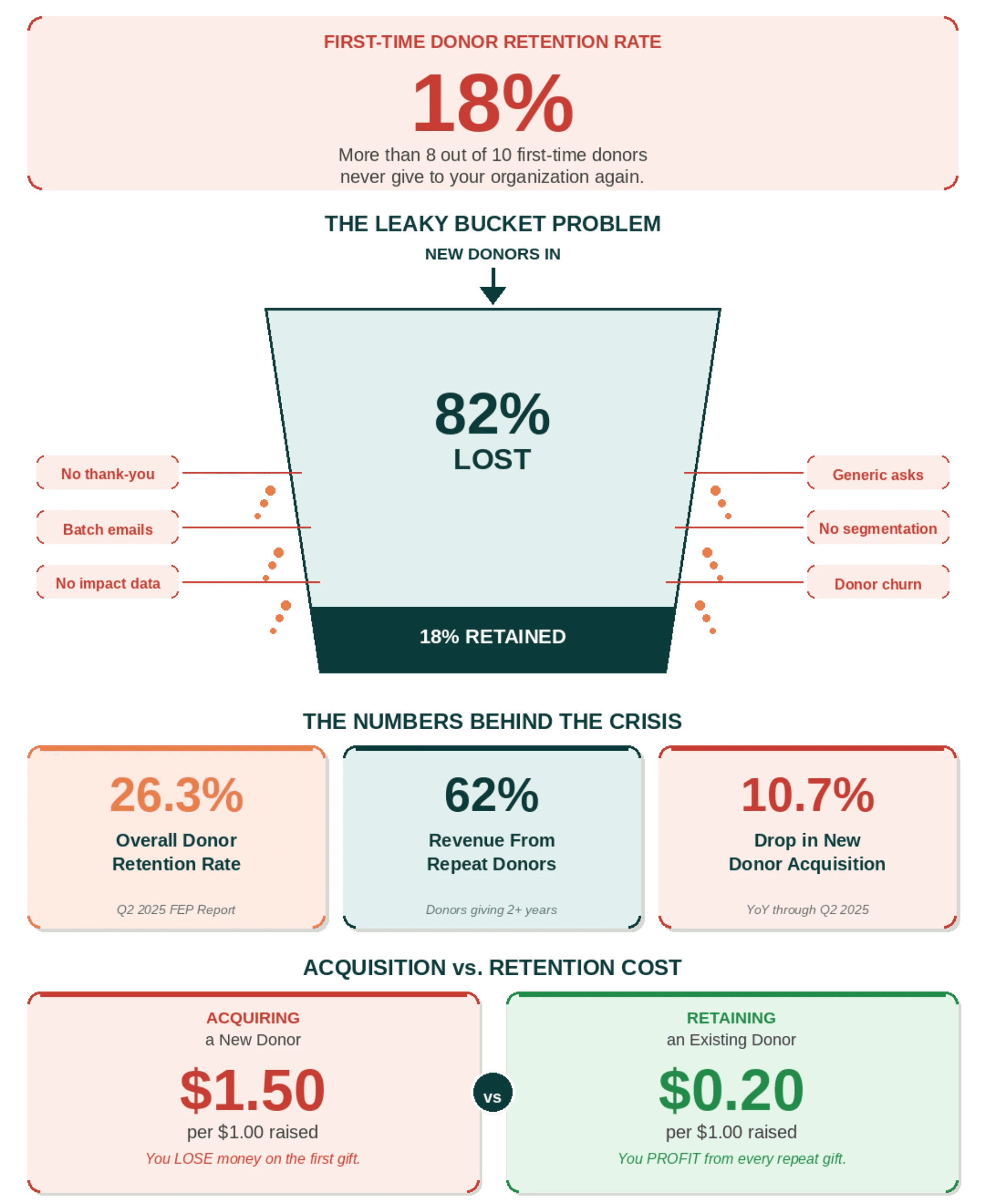
According to the Fundraising Effectiveness Project, first time donor retention has dropped to just 18.1%. That means more than 8 out of every 10 people who give to your organization for the first time never come back. Not because they stopped caring about your mission but because your organization stopped showing up in a way that made them feel connected.
This is not a fundraising problem, it is a marketing systems problem. The nonprofits that keep donors giving year after year have built structured communication systems like email sequences, segmented messaging, mapped donor journeys, and data triggers. The ones without those systems lose donors the same way a leaky bucket loses water, no matter how much you pour in.
Below are five donor retention strategies your team can start implementing within 90 days. They are grounded in the latest sector data, and each one connects directly to the email, website, and CRM tools you probably already have.
The Donor Retention Crisis by the Numbers
Before we get into solutions, take a look at what the data actually shows. These numbers are not abstract industry trends, they are showing up in your donor database right now.
Overall donor retention sits at 26.3% through Q2 2025, according to the Fundraising Effectiveness Project mid year report. That means roughly 3 out of 4 donors who gave last year did not give again this year.
New donor acquisition dropped 10.7%, and new retained donors fell 10.2% in the same period. The pipeline is getting smaller, not bigger.
Repeat donors account for more than 60% of all dollars raised. Donors who have given for 2 or more years are your most reliable revenue source, not the people you are still trying to find through Giving Tuesday or Facebook ads.
Then there is the cost comparison. Industry estimates put the cost of acquiring a new donor at up to $1.50 for every $1.00 raised. Keep an existing donor costs as little as $0.20 per dollar raised. That is not a close race.
This is not a fundraising problem, it is a marketing systems problem. Organizations with structured follow-up systems retain dramatically more donors than those relying on sporadic outreach.
And yet most nonprofits spend the majority of their marketing budget on acquisition campaigns and treat the post-gift experience as an afterthought. The result is a revolving door; new donors come in, lapsed donors walk out, and the net impact on long-term revenue stays flat. Here’s how to fix it:
Strategy 1: The 48-Hour Thank you Sequence
Most nonprofits send a tax receipt and call it a thank you. That is not a thank you. That is paperwork.
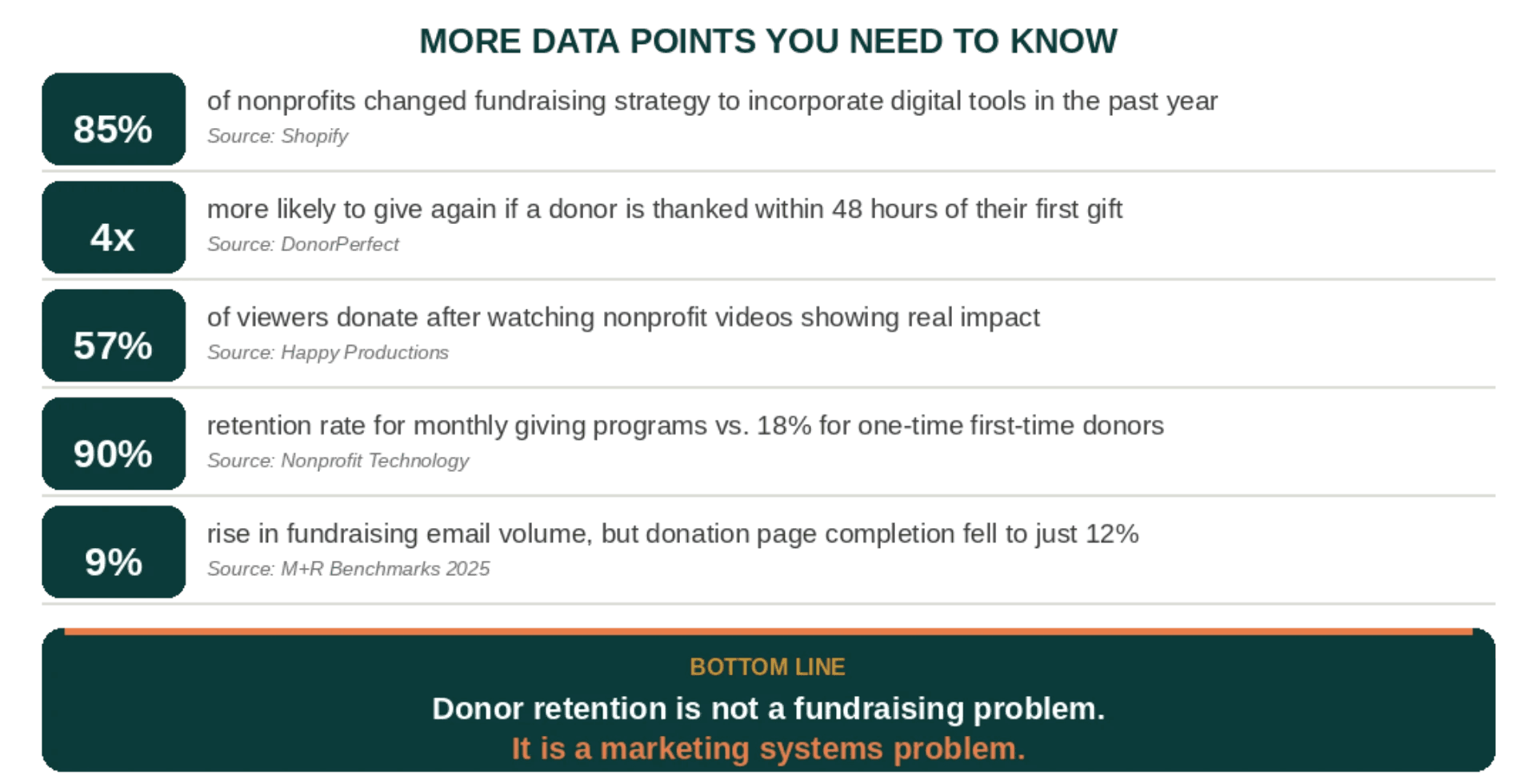
Donors are four times more likely to give again when they are thanked within 48 hours their first gift, according to DonorPerfect. That 48 hour window is the most important moment in your entire donor relationship. Not your annual gala. Not your year end campaign. The 48 hours right after someone hands you their trust and their money for the very first time.
What you need is not a single receipt email. You need a three-touch sequence:
Touch 1: Immediate automated receipt
This goes out automatically the moment the gift is processed. It should read like a note from a real person, not a system confirmation. Use the donor’s first name. Reference their specific gift amount. Tie it to something tangible. For example:
“Your $50 will provide 200 meals this month” is not just warmer than “Thank you for your generous donation.” This works better every time.
Touch 2: A personal video or staff email within 48 hours
This is where most organizations drop the ball completely. A short, genuine video from your executive director or a program staff member does more for first time donor retention than any graphic or email template you could design.
Video emails can reach open rates as high as 70%, according to DonorPerfect’s video strategy research. You do not need a production crew. A 60-second smartphone video filmed in your office is better than nothing, because it is real and donors can tell.
Touch 3: An impact preview on day 7
Seven days after the gift, send one focused message that shows what their donations is already doing. Not a vague update but a specific one. A photo, a number, a name if the situation allows it. This is the message tbat moves someone from donor to believer.
This three 3 step sequence can be built in most email platforms in a single afternoon. Once it is set up, it runs automatically every time someone gives for the first time.
Strategy 2: Segment Before Your Send
Sending the same email to every donor on your list is one of the most common and most expensive mistakes in nonprofit marketing.
The M+R Benchmarks 2025 report showed that fundraising email volume rose 9% while donation page completion fell to just 12%. More emails, less revenue per send. That is not a volume problem. That is a relevance problem.
Nonprofit email segmentation is how you fix it. Here are the four segments every organization should be using.
Gift size: Micro donors ($1 to $24), small donors ($25 to $99), mid level ($100 to $499), and major donors ($500 and up) have different motivations and different communication needs. A major donor who gets a first-time donor welcome series will notice, and not in a good way.
Recency: Someone who gave for the first time 3 weeks ago needs something completely different from someone who has given for 5 straight years. First time donors need impact proof and a sense of community. Long-time donors need recognition and insider access.
Acquisition source: A Giving Tuesday donor found you through a very different emotional door than someone who came to your gala or found you through a Google search. That entry point should shape their first messages from you.
Engagement level: If a donor has not opened your last 3 emails, they do not need another newsletter. They need a re-engagement sequence. More on this in Strategy 5.
Here is a simple example of segmentation in practice: A first-time $25 Giving Tuesday donor needs 2 or 3 impact stories that prove your organization does what it says. A repeat $500 donor needs to feel recognized, whether that is a personal note, early access to your annual report, or a behind the scenes look at a program their gift helped fund. Same organization, same mission, but completely different messages.
Strategy 3: The 90 Day Donor Journey Map
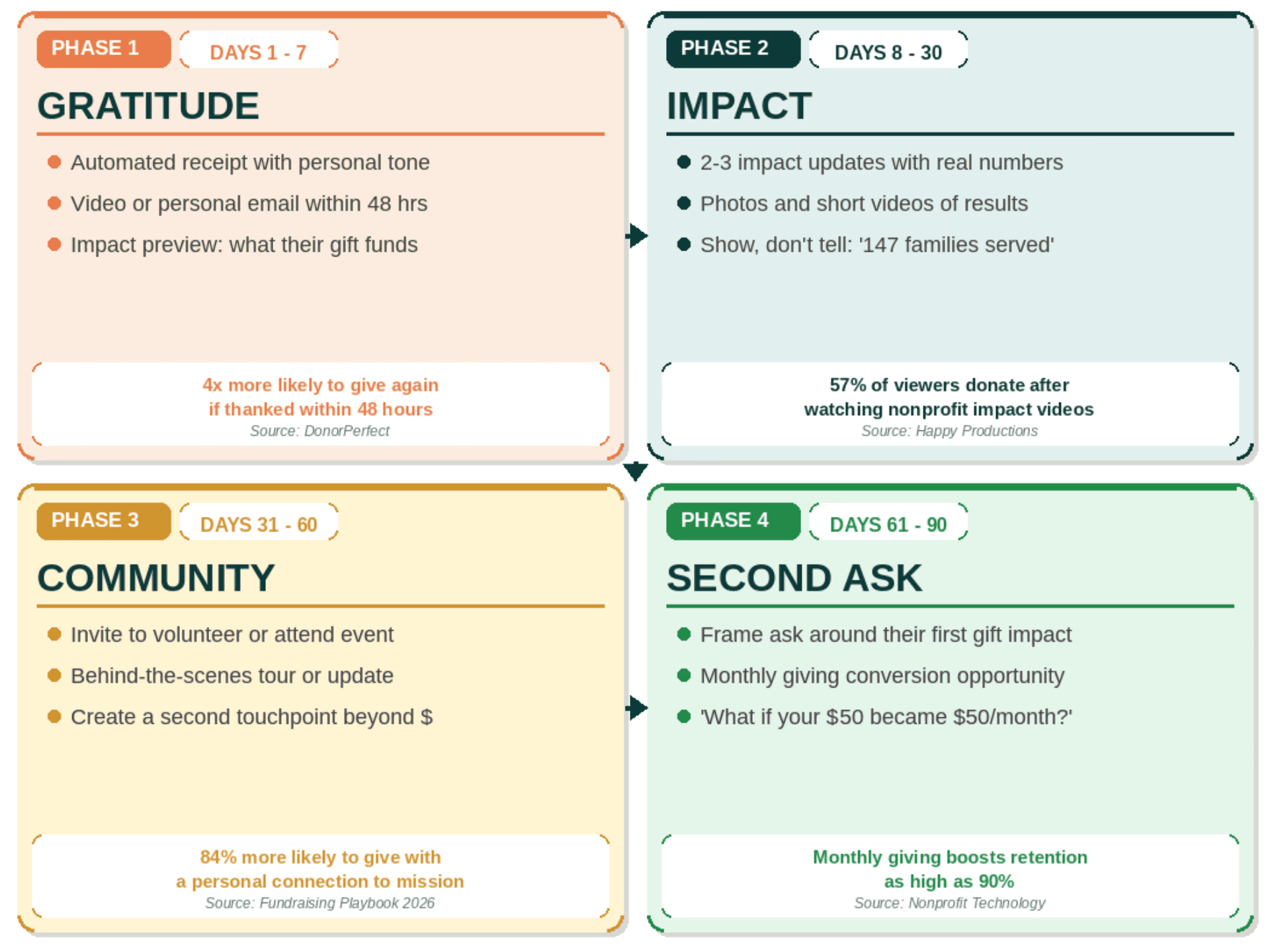
Most nonprofits reach out to donors when they need something. That is backwards. The 90 days after a first gift are your best window to build a relationship that lasts, but only if you treat that window as a structured communication period and not a waiting room for the next ask. Here is what a 90 day donor journey looks like broken into 4 phases:
Days 1 to 7: Gratitude and Connection
This is your 3 touch thank sequence from Strategy 1. The goal is simple which is to make the donor feel seen and valued. Not processed, not filed in a database.
Days 8 to 30: Impact Storytelling
Send 2 or 3 impact updates during this window. Show, do not tell. Use photos, short videos, and specific numbers. “Your gift helped us serve 147 families this month” is concrete and memorable. “ Your support makes a difference” is not.
Here is a number worth taking seriously: 57% of viewers donate after watching a nonprofit video, according to research from Happy Productions. If you are not using short form video in your donor communications, even simple unpolished smartphone video, you are leaving both engagement and revenue behind.
Days 31 to 60: Community Invitation
By day 30, your donor knows who you are. Now invite them into a deeper relationship that goes beyond writing a check. A volunteer opportunity, a behind the scenes tour, an early invitation to an upcoming event, and a private group for supporters.
The goal here is to create a second meaningful touchpoint that has nothing to do with money. Donors who volunteer, attend events, or engage with your community are dramatically more likely to give again, because they have moved from donor to community member.
Days 61 to 90: The Second Ask
When you ask again, tie it directly to their first gift. “Because of your $50 last month, we were able to do X. We are hoping to do Y by the end of the quarter and we would love your help.” Specific, achievable, connected to what they already did.
This is also your best window to introduce monthly giving. Monthly giving can boost donor retention as high as 90% compared to annual giving. The ask can be simple, “What if your $50 became a $50 a month? Here is what that would make possible.” Keep it tied to something real.
Strategy 4: Optimize Your Donation Page for Recurring Giving
Your donation page does more than collect transactions. It sets the tone for whether a donor comes back. And most nonprofit donation pages are built for one-time gifts.
Here is the single highest impact change you can make right now, pre-select the monthly giving option on your donation form. Public media organizations that default to monthly giving see up to 61% of their online revenue come from monthly donors, according to the 2026 nonprofit fundraising playbook. That is not a coincidence, it is a design choice.
Beyond that, reducing friction is one of the highest return investments you can make. Every extra field, every extra click, and every payment method you do not offer is a place where donors leave before completing their gift. Here is what a high converting donation page looks like in 2026:
Mobile-first layout: More than half of nonprofit website traffic now comes from mobile. If your form is not optimized for a phone screen, you are losing donors before they get to the submit button.
Multiple payment options: Credit card only is not enough. Offer ACH bank transfers, PayPal, Venmo, and Apple Pay or Google Pay. Each option you add removes a reason for someone to abandon the form.
Social proof on the page: A simple line near your giving options makes a difference. Something like "Join 347 monthly supporters who make our work possible year-round" increases conversion without adding any cost.
Fewer form fields: Only ask for what you need to process the gift and send a receipt. Name, email, and payment. Everything else can come later. Every extra field you add reduces your completion rate.
Strategy 5: Use Data to Predict and Prevent Churn
The most effective nonprofits in 2026 are not just reacting to donor churn after it happens. They are seeing it coming. And you do not need an expensive analytics platform to do this. You need three metrics and a few CRM triggers. The three numbers every nonprofit should be tracking:
Repeat donor rate: What percentage of donors who gave last year have given again this year? Track this monthly, not just at year-end. A healthy rate is 40 to 50 percent. Top performers hit 70% or higher, according to Keela's donor retention benchmarks.
Average gift size over time: Is the average gift from your retained donors growing, holding steady, or shrinking? A declining average is an early warning sign that your messaging is losing relevance, even if your donor count looks stable.
Time to next gift: How many days pass between a donor's first gift and their second? The shorter this window, the stronger your retention system is working.
Once you have those numbers, set up CRM triggers. The most important one: if a donor who gave last year has not opened your last three emails, do not wait for your next newsletter to reach them. Trigger a personalized re-engagement message, whether that is a text, a personal email, or a direct mail piece, within 48 hours of that signal.
The 48-hour rule is not just for thank-you messages. It applies to early churn signals too. The longer you wait to respond to a disengaged donor, the harder the re-engagement becomes.
61% of nonprofits now report using AI for development and fundraising activities, according to the Center for Effective Philanthropy. The best use of AI in donor retention is not to replace personal connection. It is to surface at-risk donors earlier so your team can reach them with a human touch at exactly the right moment.
85% of nonprofits changed their fundraising strategy in the past year to incorporate digital tools, according to Shopify's nonprofit industry trends report. The organizations hitting retention rates above 50% are the ones using those tools to build structured follow-up systems, not just to send more emails.
What Separates High-Retention Nonprofits from Everyone Else
The nonprofits retaining donors at 50% and above are not doing one dramatic thing differently. They are doing five ordinary things consistently.
They have automated thank-you sequences that go out within 48 hours of a first gift. They send segmented communications based on donor behavior and giving history. They have a mapped donor journey for the 90 days after a gift. They have built donation pages designed to convert to monthly giving. And they track three simple metrics that tell them when a donor is about to walk.
None of this requires a large team or a big budget. It requires clear systems, a bit of setup time, and the discipline to follow through. Most organizations already have the tools. What they are missing is the structure.
Your year-end donors are deciding right now whether to give again. The Giving Tuesday donors from last November are already moving on if they have not heard from you in a meaningful way. Every week that passes without a structured retention touchpoint is a week closer to losing them.
Most of this Comes down to having the right system in place
Adode Media works with Atlanta nonprofits to build systems that actually run. We have worked with organizations like Kindred Futures, NMDP, and Thurgood Marshall College Fund. We know the rhythm of nonprofit marketing because we have lived it alongside our clients.
Contact us today and let us show you exactly where your donor journey is breaking down and how to fix it. Visit our Nonprofits page to see how we can help.

Who we are!

Sign up to our Newsletters
Looking for something?
Search here…
Recent Blogs



Adode Media is a performance marketing partner for Atlanta medical practices, contractors, and nonprofits. We turn your reputation into revenue. No more relying on word of mouth alone. Just consistent, scalable growth built on the trust you've already earned.
Who We Serve
What We Do
Get the latest information
All rights reserved.