Nonprofits
Major Donor Cultivation: Close Gifts Before Summer

Most nonprofit fundraising advice tells you to focus on year-end giving. December gets all the attention. But here is the truth that experienced development directors know: spring is where major gifts are actually won or lost.
If your major donor cultivation strategy does not include a clear March through June push, you are leaving money on the table and scrambling in September to re-engage donors who were nearly ready to commit back in June. According to the Fundraising Effectiveness Project, individual giving drops an average of 14 to 18 percent in July and August compared to first and fourth quarter benchmarks. That dip is not random. It is predictable. And it is preventable if you treat spring as a closing season, not just a warm-up.
This post gives Atlanta nonprofits a step-by-step spring cultivation roadmap. You will learn how to prioritize your prospect portfolio, build a touchpoint cadence that moves donors forward, and structure a gift conversation that earns a commitment and not a "maybe I'll think about it."
Prioritize Your Spring Portfolio Before March Ends
Before you can close gifts, you need to know which prospects are actually ready. Not every donor in your pipeline belongs in your spring push. Some need more time. Some need a different approach. Spending spring energy on the wrong people is one of the most common mistakes development directors make.
Here is a simple way to sort your pool. Score each prospect on three things:
Relationship depth: How many meaningful touchpoints have you had with this person in the last 12 months? Not email blasts. Real conversations, site visits, personal notes, 1 on 1 meetings.
Financial capacity: What does your wealth screening data tell you? Tools like DonorSearch or iWave, combined with board peer screening and public giving records, give you a solid capacity picture.
Alignment signals: Has this person attended a program event? Volunteered? Reached out to you without being prompted? These behaviors show that the donor cares and not just that they have the money.
Prospects who score high on all three are your spring-closeable group. Everyone else stays in cultivation. This is not about giving up on them. It is about protecting your time and your organization’s momentum.
On portfolio size, research from AFP and Bloomerang consistently points to 125 to 150 prospects as the right number for a full-time major gifts officer to manage meaningfully. If your development director is carrying a larger list than that, spring prioritization is not just a strategy. It is a survival decision. You cannot move everyone forward at once.
One Atlanta specific tip: Cross reference your spring prospect list against Atlanta Gives Day participation data and activity within local philanthropic networks, particularly giving circles connected to the Atlanta Women’s Foundation or donor-advised fund holders at the Community Foundation for Greater Atlanta. Donors who are active in these spaces heading into spring are already in a giving mindset. That is a meaningful advantage when you are trying to time your outreach.
Build a Sequenced Touchpoint Cadence From March through June
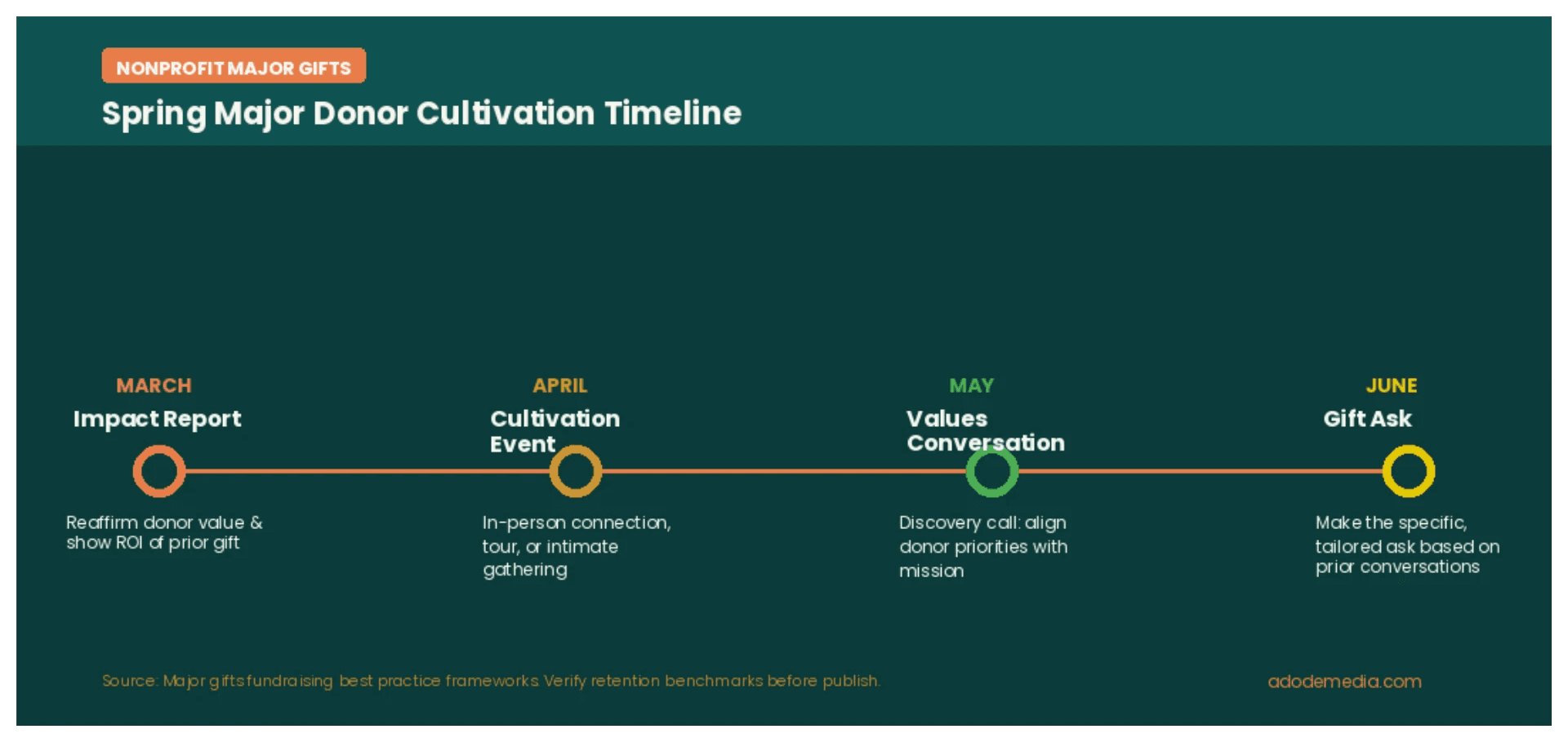
Once you know who you are working with, you need a plan for how you will move each prospect forward. Cultivation without a cadence is just relationship maintenance. You want structure, a clear sequence of touchpoints that builds toward an ask.
Here is a four touchpoint minimum for any prospect you plan to ask before June 30.
Touchpoint 1: Early March. Personalized Impact report or program update. This is not a newsletter. It is a direct communication, addressed to the donor by name, that connects your organization’s recent wins to something they specifically care about. Reference a past conversation. Make it feel like a letter, not a broadcast.
Touchpoint 2: Late March or April. Cultivation event or site visit. Bring your best prospects into your world. This does not need to be expensive. A breakfast briefing for 10 to 15 people at a Midtown or Sandy Springs venue, centered on a program outcome story told directly by a client or program graduate, almost always outperforms a large gala-style event when it comes to moving prospects toward a gift conversation. The intimacy sends a signal: your organization is confident, focused, and respects the donor’s time.
Touchpoint 3: May, 1 on 1 meeting focused entirely on the donor. This is not a pitch meeting. Do not bring a case statement. Ask questions. What matters most to them right now? What does impact look like to them? What would make a gift feel meaningful rather than transactional? Listen more than you talk. This is the most important meeting in your spring sequence because it tells you exactly how to frame the ask.
Touchpoint 4: Late May or early June. The gift conversation. This is your ask. We will cover how to structure it in the next section.
A note on digital engagement signals: your moves management work does not stop between in person touchpoints. Track what prospects are doing online. A donor who opens three consecutive program emails, clicks through to a success story, or engages with your LinkedIn content in a 30-day window is showing you something. That behavior should trigger a personal outreach call within 48 hours and not a wait until the next scheduled touchpoint. Digital signals are readiness indicators, and fast follow-up on warm signals is one of the highest ROI habits a development director can build.
Your CRM should have every touchpoint documented, every next step assigned to a specific person, and every digital engagement flag logged. If your team is not using your CRM consistently to track this activity, that gap will cost you gifts in June.
Structure the Gift Conversation to Earn a Commitment, Not a Maybe
The gift conversation is where most development directors either close the season strong or carry a list of soft maybes into summer. The difference almost always comes down to how the ask is structured. Use this 3 part framework
Step 1: Open with the donor’s story. Start by referencing something specific from your last conversation. Not something generic like “I know you care about our mission.” Something real: “When we met in May, you said what matters most to you is making sure kids in South Atlanta have access to mentors who look like them. I have been thinking about that. “This signals that you were listening. It removes the transactional feeling that donors dread.
Step 2: Connect their values to a concrete opportunity. Tie what the donor told you directly to a specific funding opportunity with a real dollar amount and a clear outcome attached to it. “A gift of $25,000 funds two full-time mentors for the school year and directly serves 60 students in the Lakewood community. “The ask should be specific. Specific asks with named impact statements lead to higher first-conversation commitment rates than vague asks or ranges, according research from Penelope Burk’s Donor-Centered Fundraising work through Cygnus Applied Research.
Step 3: Ask directly, then stop talking. Make the ask clearly. Then be quiet. Silence after an ask is uncomfortable, but it is working. Jumping in to soften the ask or add qualifiers is one of the fastest ways to undermine the moment you just built.
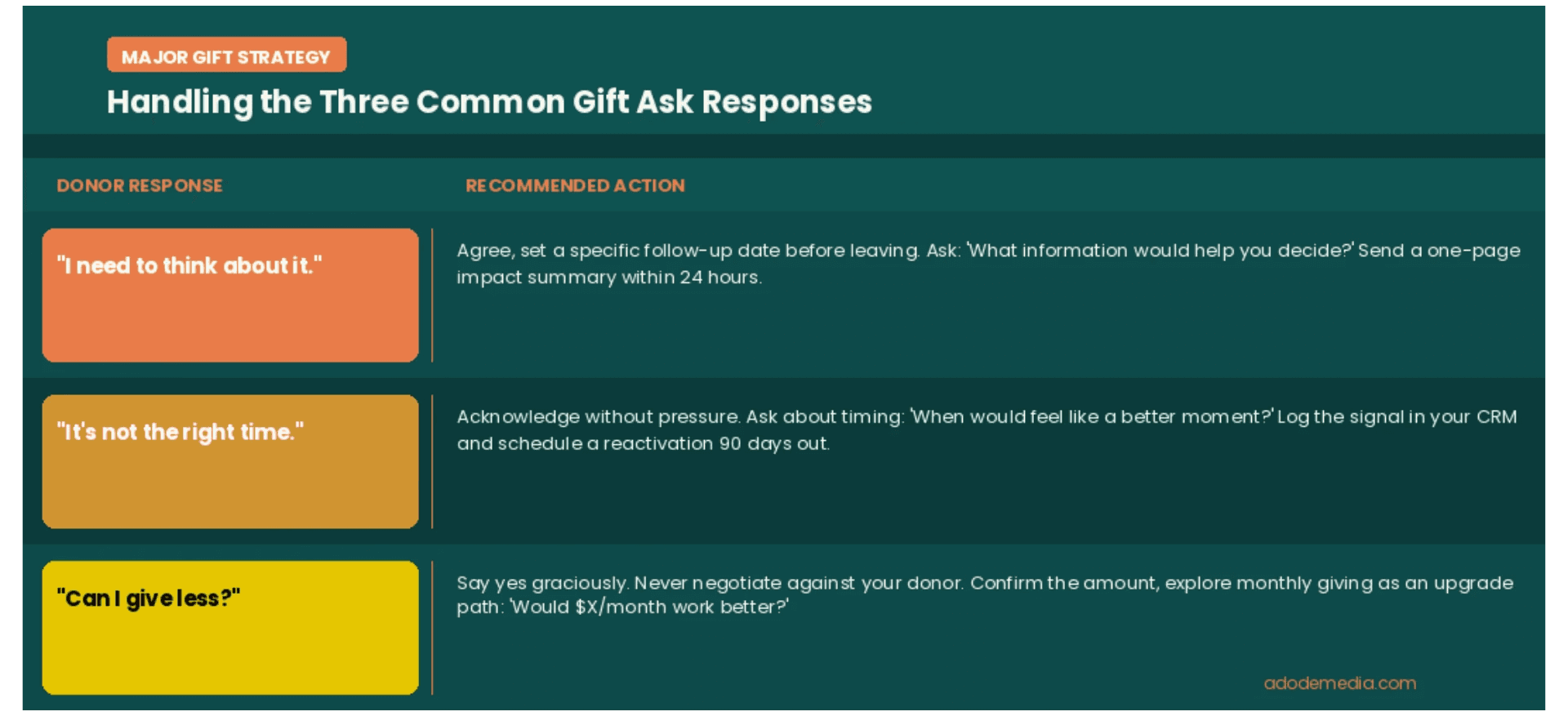
Prepare for these 3 common responses:
"I need to think about it." This is not a no. Send a one-page gift summary within 24 hours and schedule a follow-up call within 10 days. Keep the momentum going.
"It's not the right time." Ask one follow-up question: what would make the timing better? Then document the answer. That answer tells you when to come back and what to say when you do.
"Can I give less?" Have a secondary gift level ready with its own impact statement. "A gift of $15,000 funds one mentor for the full year and serves 30 students." Make the smaller gift feel as meaningful as the original ask, because it is.
None of these responses are rejections. They are negotiation openings. Treat them that way.
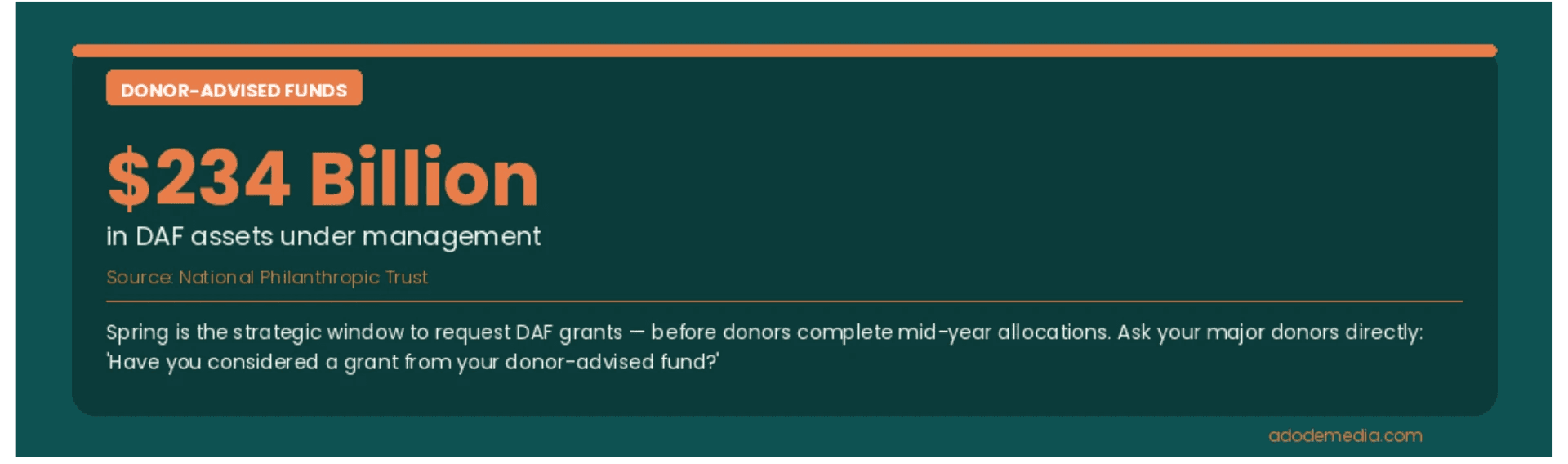
A special note for donors with donor-advised funds: if your Atlanta-area prospects hold donor-advised funds through the Community Foundation for Greater Atlanta or Fidelity Charitable, spring is one of the best times to request a DAF grant recommendation. According to the National Philanthropic Trust, donor-advised fund assets exceeded $234 billion nationally as of 2022, and that number has continued to grow. Many donors have available DAF balances they are not actively thinking about deploying. A gentle, well-timed reminder in May or early June, before summer travel schedules kick in, removes a common friction point and can accelerate a commitment that might otherwise drift into fall.
Gift ask timing matters. Spring gives you a window. DAF outreach in May or early June is one of the most reliable ways to use it.
Enter Summer With Commitments, Not Maybes
Development directors who treat March through June as a structured closing window do not just have a better spring. They have a better fall. They enter summer with secured commitments, strong relationships, and momentum instead of a list of warm prospects who went cold and now need to be re-ultivated from scratch.
The summer giving slowdown is real. But it is not something that happens to you. It is something you either prepare for or ignore. Spring is your last high-engagement window before donor attention scatters. Use it like it.
Working with Atlanta nonprofits on nonprofit fundraising strategy is what Adode Media also do. We help nonprofits build the digital content layer that keeps major donors engaged between personal touchpoints and content that signals organizational credibility at every stage of cultivation.
If your team is heading into spring without a clear digital engagement strategy supporting your major gifts work, visit our nonprofit page to learn how we work with organizations like yours, or contact us today. We will show you exactly where the gaps are and how to close them before summer arrives.

Who we are!

Sign up to our Newsletters
Looking for something?
Search here…
Recent Blogs



Adode Media is a performance marketing partner for Atlanta medical practices, contractors, and nonprofits. We turn your reputation into revenue. No more relying on word of mouth alone. Just consistent, scalable growth built on the trust you've already earned.
Who We Serve
What We Do
Get the latest information
All rights reserved.