Marketing
Medical
HIPAA Compliant Tracking: What Atlanta Medical Practices Get Wrong

Over 70% of medical practices are unknowingly running non-compliant tracking on their websites right now. That is not a small edge case. That is the majority of healthcare practices in the US and there is a good chance yours is one of them.
At the same time, the US Department of Health and Human Services (HHS) has collected more than $144.8 million in civil monetary penalties for HIPAA violations to date. These are not just fines handed to large hospital systems. Small practices, dental offices, and specialty clinics have all been on the receiving end.
Here is what makes HIPAA-compliant marketing so tricky, most practice managers assume their website is compliant because their Electronic Health Record (EHR) system is. But your EHR and your marketing stack are two completely different worlds. The tools that power your website: Google Analytics, Meta Pixel (Facebook's tracking tool), contact forms, appointment request buttons: operate in a separate compliance universe that most practices never audit.
In this blog, we will walk through the five most common HIPAA tracking violations, what compliant alternatives actually look like in 2026, and why fixing your tracking setup will actually improve your marketing results: not hurt them.
Why Your Website Tracking Is Probably Violating HIPAA
Most people think of HIPAA as something that protects medical records inside a clinic. But in 2022, the HHS Office for Civil Rights (OCR) published a bulletin that changed the picture for everyone running a healthcare website. That bulletin made it clear that tracking technologies used on healthcare websites can create HIPAA violations: even when no one is filling out a medical form.
The reason comes down to what counts as Protected Health Information, or PHI. PHI is not just a diagnosis or a test result. It can be any information that connects a person to a health condition. When your website uses standard analytics tools, here is what can happen:
Google Analytics collects IP addresses. It also records which pages a user visits. If someone visits a page like '/services/diabetes-management' or '/contact-us' after browsing your cardiology practice, their IP address combined with that page visit can qualify as PHI.
Meta Pixel (formerly Facebook Pixel) sends user behavior data directly to Facebook servers. Facebook will not sign a Business Associate Agreement (BAA): the legal contract required under HIPAA before any third party can access patient data. Without a BAA, that data transfer is a violation.
Standard contact and appointment forms often send data through unsecured channels, leaving patient information exposed at rest or in transit.
Note: Facebook, Google, and LinkedIn Ads will not sign BAAs for standard accounts. If your tracking setup relies on any of these tools without additional safeguards, you are likely already non-compliant (Paubox).
The consequences are real. A North Carolina dental practice was fined $50,000 after disclosing patient information in a Google review response. That example shows something important: HIPAA violations in marketing do not require a data breach. A single public comment, a pixel firing on the wrong page, an unsigned vendor agreement: any of these can trigger an investigation.
The HHS has collected over $144.8 million in civil monetary penalties as of 2024, and enforcement is increasing as regulators pay more attention to digital marketing practices in healthcare.
The 5 Most Common HIPAA Tracking Mistakes Medical Practices Make
These are the violations that come up again and again when practices finally sit down to audit their marketing setup.
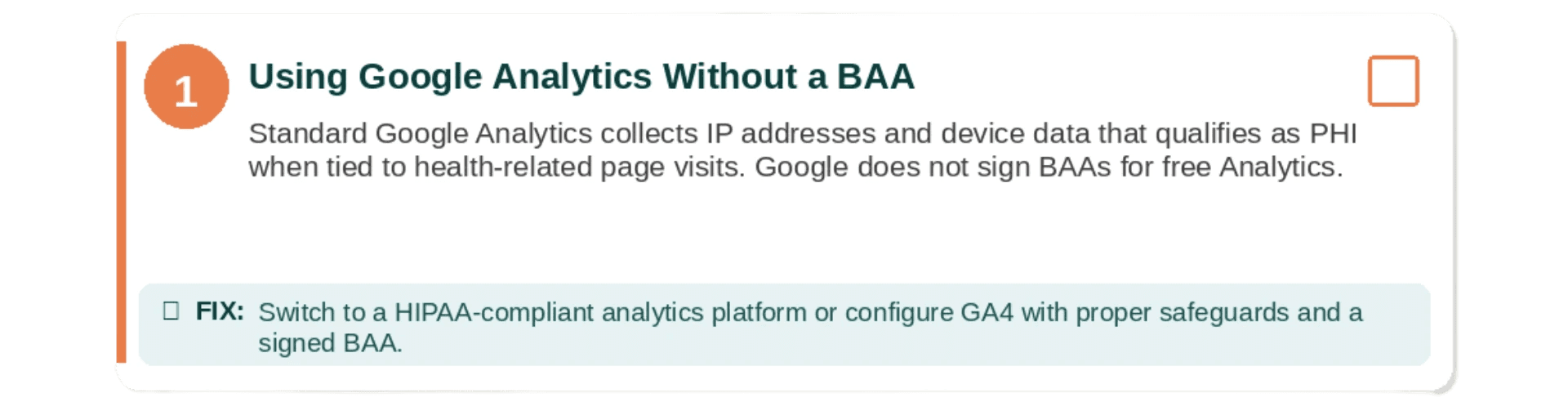
Mistake 1: Running Google Analytics Without a BAA or Consent Framework
Google does not sign BAAs for standard Google Analytics 4 (GA4) accounts. That alone is a problem. But it gets more specific: if your website collects form submissions (like appointment requests or contact inquiries) and you also run GA4 on those same pages, you now have a situation where health-related user behavior is being tracked and sent to a third party with no BAA in place.
This is one of the most common HIPAA marketing rules violations because GA4 is free, easy to install, and nearly universal. Most practices set it up without thinking about what it actually sends out.
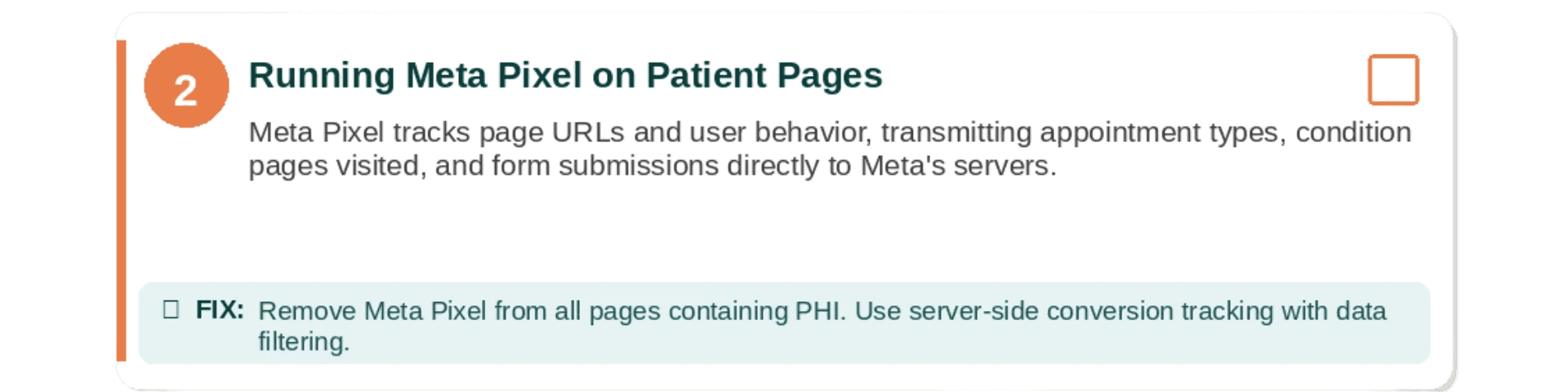
Mistake 2: Using Meta Pixel on Pages That Collect or Imply Health Information
You do not need a patient to fill out a form for a violation to occur. Simply visiting a page can be enough. A URL like '/services/fertility-treatment' combined with a Meta Pixel firing on that page creates a data point that links a person to a health condition. Facebook receives that data. Facebook will not sign a BAA. That is a problem.
For practices running paid social media ads, this is particularly important. The Meta Pixel is often installed site-wide, which means it fires on every page: including sensitive service pages that imply a health condition.
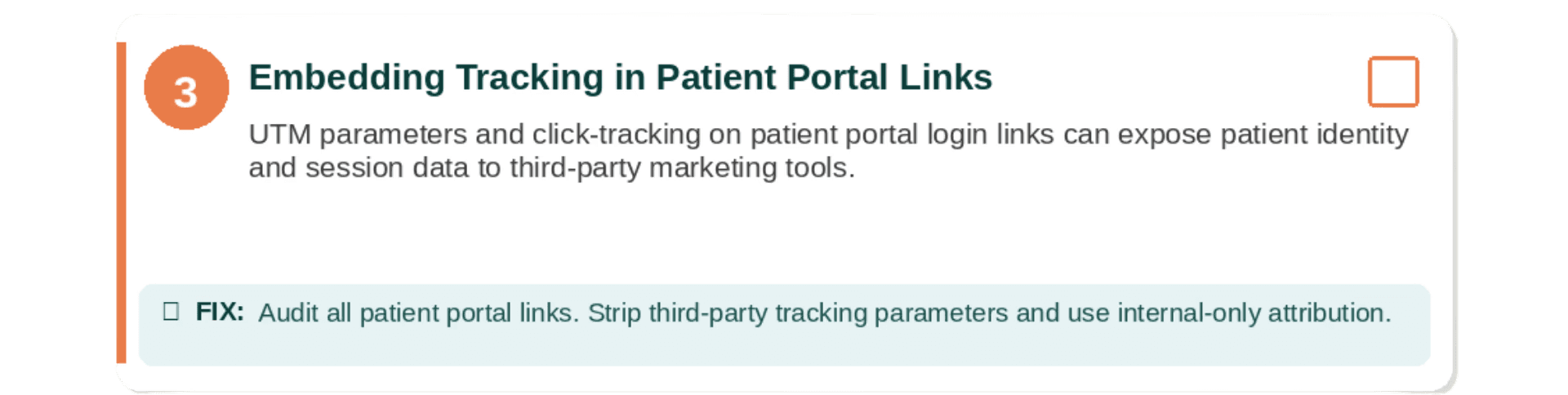
Mistake 3: No Encryption on Contact or Appointment Request Forms
Many practices believe that having an SSL certificate (the padlock icon in a browser) means their forms are secure. SSL encrypts data in transit, which is a good start. But HIPAA requires encryption both in transit AND at rest: meaning the data also needs to be encrypted once it lands in your inbox or CRM. Standard WordPress contact forms, email forwarding, and basic web hosting typically do not meet this standard.

Mistake 4: Your Marketing Agency Does Not Have a Signed BAA
This one surprises a lot of practice owners. Under HIPAA, any vendor that accesses patient data: even indirectly: is considered a Business Associate. If your marketing agency has access to your website form submissions, your email marketing system, or your analytics data, they are a Business Associate under the law.
If you do not have a signed BAA with your agency, you are out of compliance. It does not matter how trustworthy they are. The signed agreement is required. This applies to web developers, SEO agencies, social media managers, and any consultant who touches your patient data or marketing stack.
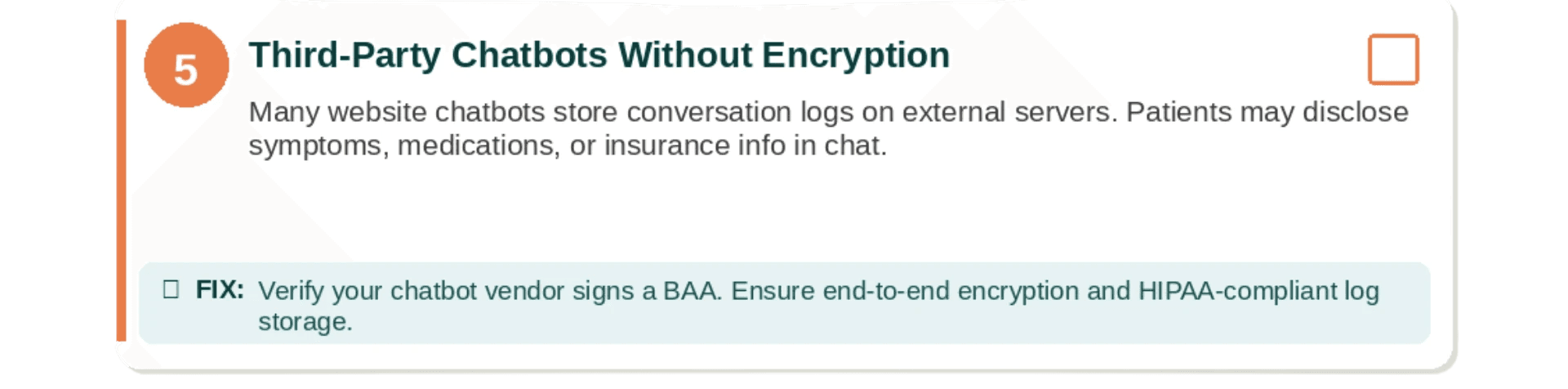
Mistake 5: Responding to Online Reviews With Patient Details
The $50,000 fine against the North Carolina dental practice mentioned earlier came from this exact mistake. When a patient left a negative review, the practice responded in a way that confirmed the person was a patient and referenced details about their visit. That is a direct disclosure of PHI in a public space.
Here is what a compliant response looks like instead:
"Thank you for sharing your experience. We take all patient feedback seriously and are committed to providing high-quality care. We encourage you to contact our office directly so we can address your concerns."
Notice what that response does not do: it does not confirm the person is a patient, it does not reference any details of a visit, and it does not disclose any personal information. Keep it general, keep it professional, and always take the conversation offline.
What HIPAA Compliant Tracking Actually Looks Like in 2026
Here is the good news: fixing your tracking setup does not mean giving up on marketing data. In fact, privacy-first healthcare marketing often produces better data: not worse.
According to Intrepy Healthcare Marketing's 2026 trends report, privacy-safe tracking improves lead-quality signals by up to 30% because it filters out spam and bot traffic that inflates standard analytics numbers. When you clean up your tracking, you get a clearer picture of who is actually reaching out to your practice.
So what does compliant tracking actually look like? The core idea is building a first-party data ecosystem: a setup where your practice owns the data and controls how it moves, rather than relying on third-party pixels that send data to outside servers.
Here are the key components of a compliant marketing setup in 2026:
Server-side analytics: Instead of firing tracking scripts directly in the browser (which sends data to third parties), server-side analytics routes data through your own server first. This gives you far more control over what gets shared and with whom.
HIPAA-compliant form providers: Tools like Hushmail, Formstack with HIPAA settings enabled, or Spruce Health are designed specifically for healthcare. They encrypt data at rest and in transit and will sign a BAA.
Privacy-first tracking platforms: Platforms like Piwik PRO or Matomo can be configured to comply with HIPAA requirements, unlike GA4 in its default state.
Consent management tools: A properly configured cookie consent banner that gives patients control over tracking is both a legal best practice and a trust signal for new patients.
Compliant tracking also flows directly into better business outcomes. At Adode Media, we bring more than 10 years of healthcare revenue cycle experience led by our Founder/CEO Ona Oghogho to connect the dots between marketing compliance and practice revenue. Clean, compliant data from your website means better patient attribution, more accurate cost per acquisition numbers, and smarter decisions about where to put your marketing budget. When your data is trustworthy, your marketing gets sharper.
How to Audit Your Practice’s Marketing Compliance
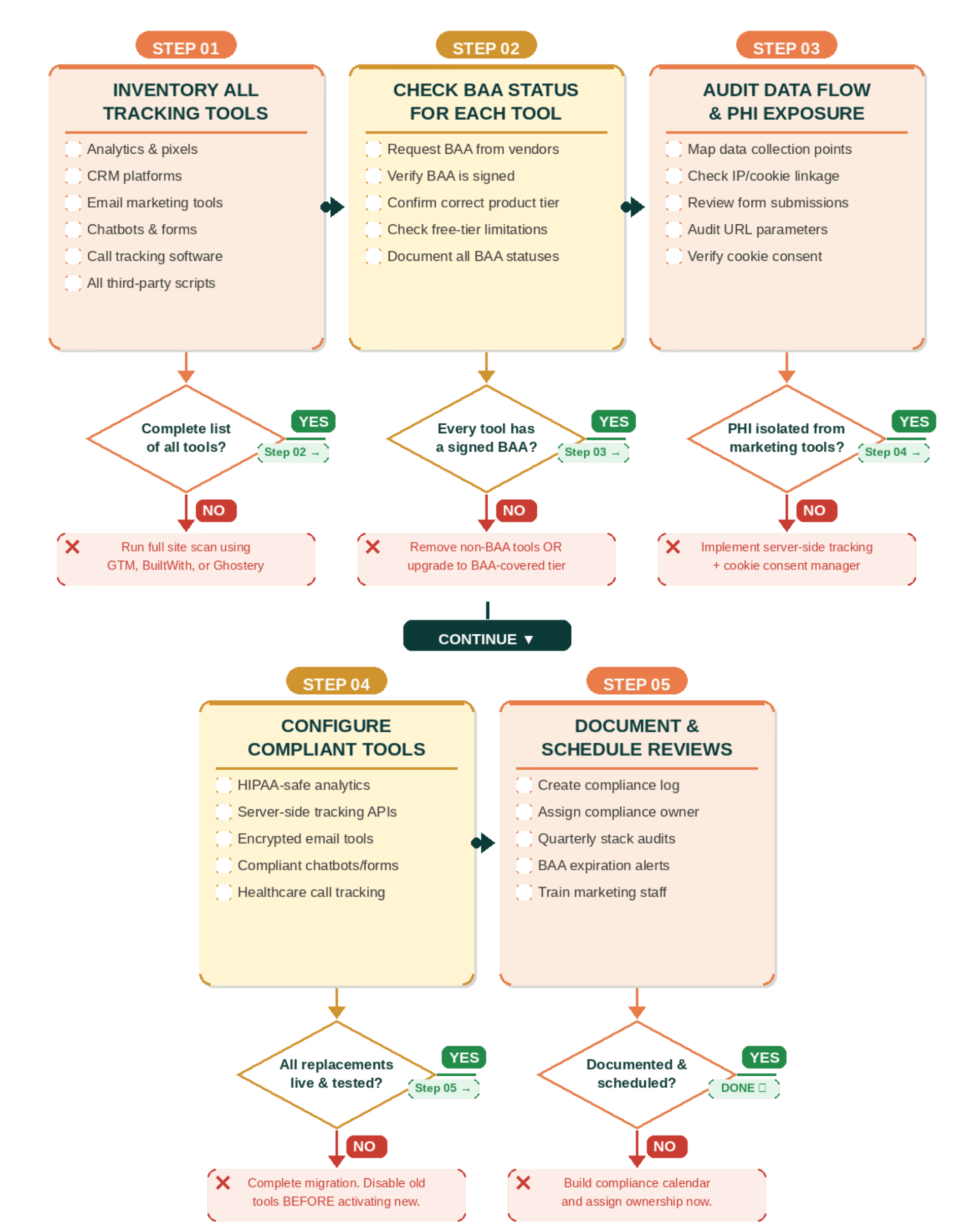
You do not need to hire a compliance attorney to take a first pass at this. Here is a step by step audit you can run right now:
Inventory every tracking script, pixel, and form on your website. Ask your web developer or agency for a list of all third-party scripts running on your site. If you have access to Google Tag Manager or your website's source code, look for any pixel, tag, or script that sends data to an outside server.
Check which vendors have signed BAAs with your practice. Go through your vendor list: your analytics platform, your email marketing tool, your CRM, your appointment scheduling software. Do you have a signed BAA with each one? If not, that is a gap.
Review your agency relationship for BAA coverage. If you work with a marketing agency, web developer, or SEO consultant who has any access to patient data or your marketing stack, they need a signed BAA. Reach out and get that signed if it does not exist.
Audit your review response history for PHI disclosure. Go back through your Google, Yelp, and Healthgrades responses. Did any of them confirm a person was a patient? Reference visit details? If so, flag those for your compliance file and make sure your team knows the compliant response template going forward.
Test your form encryption. Submit a test entry through each contact or appointment form on your site. Then trace where that data goes: which email address does it land in? What system stores it? Is that system HIPAA-compliant? Does the provider sign a BAA?
Treat this as a quarterly task, not a one-time fix. Your marketing stack changes when you add new tools, work with new vendors, or launch new campaigns. A quarterly check keeps you ahead of the risks.
Why Atlanta Practices Face Unique Compliance Pressure
Metro Atlanta has one of the most competitive healthcare markets in the Southeast. From Buckhead and Midtown to Sandy Springs, Marietta, and Alpharetta, practices in every specialty are competing for the same patients: and most of them are using digital marketing to do it.
On top of that, 77% of patients use search engines before booking with a new provider. That means your website is almost always the first place a potential patient encounters your practice. How your site handles their data: and whether it does so transparently: shapes their first impression of you.
Georgia does not have a comprehensive state privacy law beyond HIPAA. But if your practice serves patients who travel in from states with stricter laws, such as California's CCPA (California Consumer Privacy Act), you may have additional obligations that go beyond what HIPAA requires. This is increasingly common for specialty practices that draw patients from outside the immediate metro area.
There is also a competitive angle here that most practices miss. Practices that market their compliance as a trust signal are starting to stand out. A clear privacy notice, a visible HIPAA-compliant badge on your appointment form, and transparent language about how you protect patient data all signal to prospective patients that you take their information seriously. In a crowded market, that matters.
The Onspire Health Marketing 2026 report, published in February 2026, identified privacy-first marketing as one of the top trends in healthcare marketing for the year. Practices that get ahead of this now will have a head start on the competition.
The Bottom Line Here
HIPAA-compliant marketing is not just a legal requirement you need to check off. It is a real competitive advantage. When your tracking setup is clean and compliant, you get better data, stronger patient trust, and higher conversion rates from your marketing spend. When it is not, you are exposed to financial penalties and reputational damage that no practice can afford.
The five mistakes we covered: running unchecked analytics, using Meta Pixel on sensitive pages, using unencrypted forms, working with agencies without BAAs, and disclosing PHI in review responses: are fixable. The audit checklist above gives you a clear starting point.
And if you want expert eyes on your setup, we are here to help. You can also Download the free Google Business Profile Checklist here or you can visit contractors page.

Who we are!

Sign up to our Newsletters
Looking for something?
Search here…
Recent Blogs




Adode Media is a performance marketing partner for Atlanta medical practices, contractors, and nonprofits. We turn your reputation into revenue. No more relying on word of mouth alone. Just consistent, scalable growth built on the trust you've already earned.
Who We Serve
What We Do
Get the latest information
All rights reserved.